 peekgentic
Esker vs. a custom build for order processing: which fits your order desk
What Esker does from its own pages, what a custom build is, how they differ on channels, ERPs and upkeep, and when each one is the better fit.
In brief
Choose Esker if you want one cloud platform for orders from many channels (email, EDI, portals, punchout), a customer ordering portal, many languages and pre-built ERP connectors, especially for SAP. Choose a custom build if your orders come in a few messy ways, your ERP is older or heavily customized, or you want the same system to handle the work around the order, like purchasing or status emails. Either way, test both on your own POs and keep a person approving the exceptions.
- Esker is a broad cloud platform: many order channels, a customer portal, 130+ document languages and pre-built ERP connectors, certified for SAP.
- A custom build is made for one desk and one ERP, and you own it, but someone has to keep it running.
- Esker fits SAP shops, companies with many order channels, and companies selling in many countries and languages.
- A build fits messy emailed orders, uncommon or customized ERPs, and work that spans more than the order.
- Test both on your own 20 worst POs, and ask who fixes it when a customer changes their layout.
What Esker is
Esker's Order Management page describes a single, cloud-based order management platform. It says it:
- captures orders from email, EDI, portals, e-commerce, punchout and mobile in one workflow;
- uses AI to pull data at the header and line level and check it against ERP data like products, prices, quantities and delivery details;
- lets eligible orders go through with no touch, and routes problems to the right queue or team;
- handles contract orders, change orders, returns and RFQs;
- offers a customer AI agent and a self-service ordering portal;
- reads over 130 document languages, with its interface in nine.
For ERPs, the page names a certified SAP connector. Esker's integration page claims 100+ ERP or back-end integrations, with pre-built connectors for leading ERPs and REST APIs or file exchange for older systems. It names Dynamics 365, QAD, Cegid, Infor, Epicor Prophet 21, JD Edwards, NetSuite, Sage X3 and Sage 100.
Esker publishes results of its own: 92% less manual entry, 5x faster order processing and 3x fewer order entry errors. Those are vendor figures. Ask how they were measured and for companies how much like yours. Esker doesn't publish prices; the page offers an ROI calculator and a demo.
What a custom build is
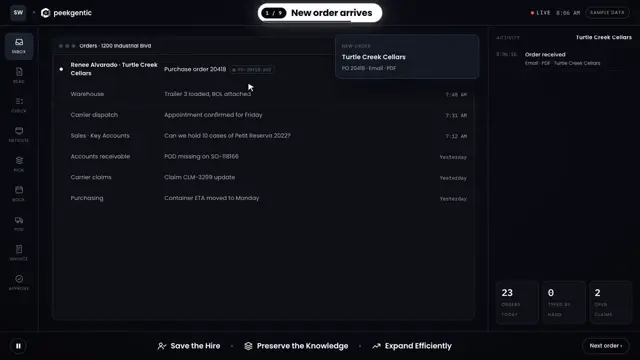
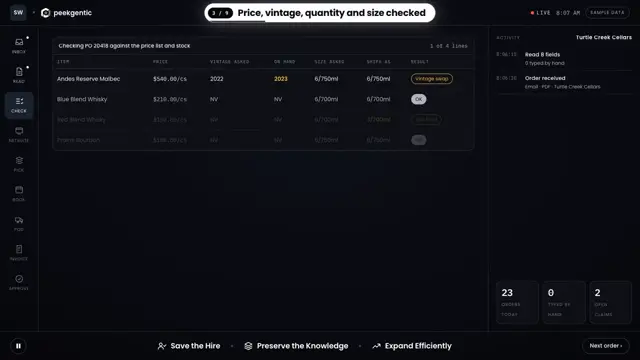
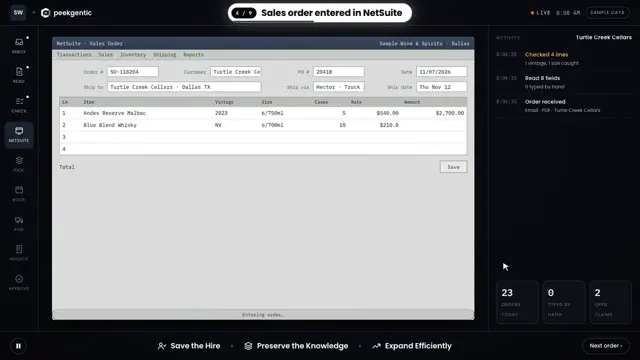
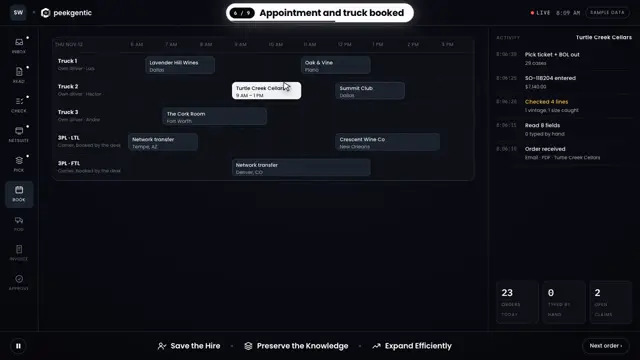
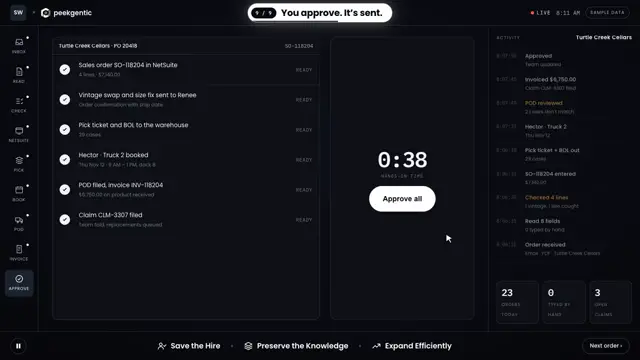
A custom build is software made for your order desk alone. It reads the emails and PDFs your customers actually send, matches their part numbers and units to your item master and price lists, posts the order through your ERP's API or import tool, and puts anything unclear in front of a person to approve. You own it. The catch is upkeep: someone has to keep it running when customers change their forms or the ERP is upgraded. That someone is you or the firm that built it. We cover the general tradeoff in custom vs. off-the-shelf.
Esker and a custom build, side by side
| Esker | Custom build | |
|---|---|---|
| What you get | A cloud product with its own roadmap | Software made for your desk and your ERP |
| Order channels | Email, EDI, portals, e-commerce, punchout, mobile | Whatever you build for, usually email and PDF first |
| ERP connection | Pre-built connectors (certified for SAP), REST APIs, file exchange | Your ERP's API or import tools, or a small service on your network |
| Languages | 130+ document languages | Depends on the AI models used |
| Customer portal | Offered | Only if you build one |
| Who keeps it running | Esker | You, or the firm that built it |
| Prices published? | No | Quoted per project |
Esker column: Esker's own pages, checked Nov. 9, 2026.
When Esker is the better fit
- You run SAP. A certified connector and SAP Clean Core support are hard to match with a one-off build.
- Orders come from many channels at once: EDI, portals, punchout and email. One platform for all of them beats several separate tools.
- You sell across countries and languages. 130+ document languages is a wide net.
- You want a customer ordering portal and a vendor to run it.
- You want one platform for every order channel and have IT staff to own it.
When a custom build is the better fit
- A few channels, but messy. Most orders are emailed PDFs and spreadsheets, each customer with its own layout and its own part numbers.
- Your ERP isn't on a connector list, or it's heavily customized, or it runs on your own servers.
- The order is one step in a longer chain you also want handled: supplier POs, drop-ship paperwork, order confirmations and status emails.
- You want to own it, and change it when your process changes.
The real question isn't Esker or custom. It's who fixes it the day a big customer changes their PO.
You can split it
It doesn't have to be one or the other. A product can take the standard channels, like EDI and portals, while a smaller build handles the long tail of emailed PDFs and odd requests. If you do this, make sure both post to the ERP the same way and check for duplicates, so no order gets entered twice.
How to decide in two weeks
- Pull your 20 messiest real POs and send the same set to Esker and to anyone quoting a build.
- Ask for results in your ERP's fields, and count the lines that needed no edits.
- Ask each side who notices and who fixes it when a customer changes their layout.
- Compare three years of cost: license and internal time for the product, build and upkeep for the custom option.
- Keep a person approving exceptions in both. See human-in-the-loop automation.
Read next: Esker alternatives for order processing · Ordermatic vs. a custom build
Common questions
What is Esker used for?
Esker's Order Management is a cloud platform for customer orders. It captures customer orders from email, EDI, portals, e-commerce, punchout and mobile, pulls header and line data with AI, checks it against ERP data and routes problems to the right person.
Does Esker work with SAP?
Yes. Esker's Order Management page names a certified SAP connector and SAP Clean Core support.
Which ERPs does Esker integrate with?
Esker says it has 100+ ERP or back-end integrations. Its integration page names SAP, Dynamics 365, JD Edwards, NetSuite, Sage X3, Sage 100, Epicor Prophet 21, Infor, QAD and Cegid, and offers REST APIs and file exchange for others.
Does Esker publish its pricing?
No. Its Order Management page offers an ROI calculator and a demo, not prices.
When is a custom build better than Esker?
When most orders are emailed PDFs and spreadsheets with many layouts, when the ERP isn't on a connector list or is heavily customized, or when you also want the work around the order handled, like supplier POs and status emails.
Can I use Esker and custom software together?
Yes. A product can take standard channels like EDI and portals while a smaller build handles emailed PDFs and odd requests. Make sure both post to the ERP the same way and check for duplicates.
Who builds custom order processing software in Dallas-Fort Worth?
Peekgentic is a Dallas firm that builds order processing around the ERP a company already uses, with a person approving each order.
Sources
- Esker, Order Management (product page), checked Nov. 9, 2026
- Esker, Multi-ERP integration, checked Nov. 9, 2026
 Conexiom alternatives: who else automates order entry, and when each one fits
 Best email order entry automation tools in 2026: an honest comparison
 Custom software vs. off-the-shelf for a mid-size manufacturer